
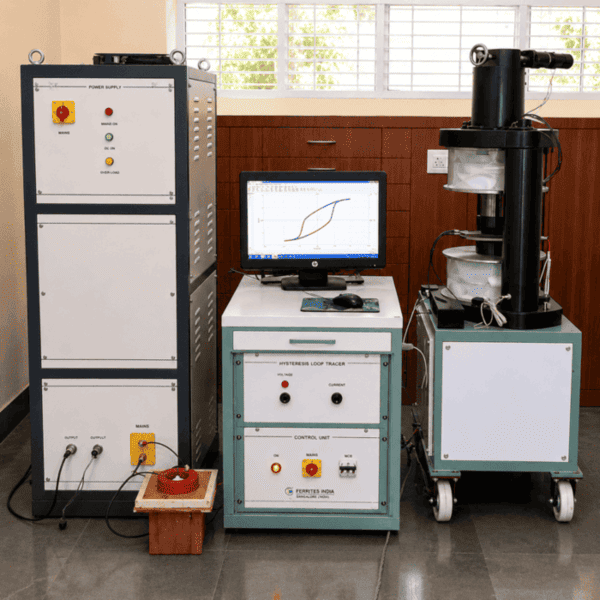
Magnet And Powder Tester
H30 Series:
AlniCo, Ferrite, NdFeB, SmCo5, Sm2Co17 magnets are tested and their B-H and MH loops are plotted using Ferrites India make H30 series hysteresis loop tracers. The complete system consists of a magnetizer to magnetize the test piece, an electromagnet and a BH Loop Plotter. Magnets with coercivity as high as 13 kOe and more can also be tested.
Specifications:
- State of Art, Indigenous Equipment for testing of Magnets.
- Wide Material Type Testing—Ferrite, AlNiCo, Rare Earth—NdFeB, SMCO₃, Sm₂CO₁₇.
- ASTM/ IEC /IS Standard Compliance.
- Measurement Accuracy—1%.
- Measurements up to 18000 Oe
- Magnet Shape—Rectangular, Ring, Cylinder, Segments
- Measurements with Surround Coils and Pole Coils
- BH Loop Graphical Display
- Calibration Traceable to International Samples
- Variety of Magnetic Properties tested
- Fully computerized system, Very Low Measurement Time,
- Data Automatically Generated and Saved.
- No Operator Skill Required, Easy Installation and Operation.
- All accessories Supplied for Smooth Running.
- Detailed Test Reports for Design Applications.
Applications:
- Motor Manufacturing
Qualifying rare earth and ferrite magnets used in permanent magnet motors, BLDC motors, and servo motors for consistent magnetic performance. - Fan Manufacturing
Testing ferrite and rare earth magnets used in fan motors to ensure correct magnetic strength and grade before assembly. - Aerospace
Qualifying high-coercivity magnets up to 18000 Oe used in aerospace actuators, sensors, and flight-critical power systems. - Defence
Testing NdFeB and SmCo magnets used in defence guidance systems, radar components, and military-grade electromechanical devices. - Magnetic Separator Industry
Verifying magnetic strength of rectangular, ring, and segment magnets used in industrial magnetic separators for mining and food processing. - R&D Laboratories
Plotting complete BH and MH hysteresis loops for new magnet material development and grade comparison research. - Educational Institutions
Demonstrating BH loop characteristics of different magnet grades for physics and magnetic engineering students.
FAQ:
- How can I verify whether a magnet meets its specified magnetic strength? A magnet tester measures key magnetic parameters to ensure the magnet performs according to design and application requirements.
- Why do two magnets of the same size show different performance? Differences in material grade, manufacturing process, magnetization quality, and operating conditions can affect magnetic performance.
- What causes a permanent magnet to lose its magnetic strength? Excessive heat, mechanical shock, and exposure to opposing magnetic fields can lead to demagnetization.
- Can magnet testing help prevent product failures? Yes. Detecting weak or defective magnets early helps avoid performance issues and costly field failures.
- Why is magnet testing important for EV motors and generators? Accurate magnetic performance directly impacts efficiency, torque output, energy consumption, and reliability.
- Why is magnetic powder testing important before manufacturing? Testing ensures the magnetic powder meets required specifications before compaction and final processing.
- How does powder quality affect magnetic component performance? Powder characteristics influence permeability, core loss, saturation levels, and overall efficiency.
- How does powder testing support material development? Researchers use powder testing data to optimize formulations for specific applications and operating conditions.