
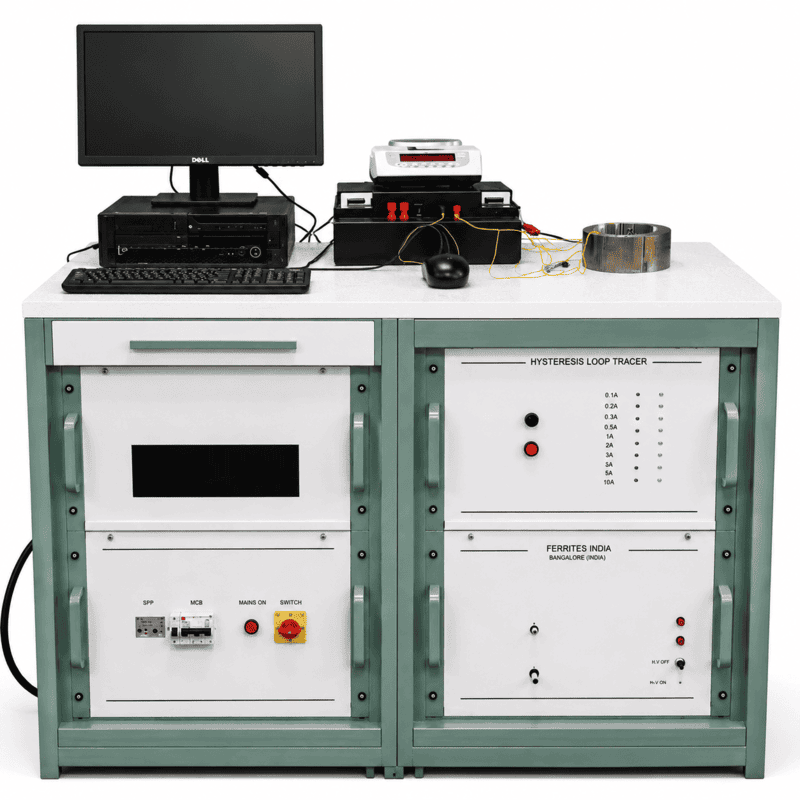
Epstein Tester
Incoming material inspection can be very useful where strict quality standards are maintained. It saves a lot of processing cost since lossy material is inspected at the entry level before it goes to production level. Epstein Stack testing is one of the oldest and widely used method for electrical sheet testing. Ferrites India Make Epstein Square Tester adhere to ASTM, IEC and IS standards and provide accurate results.
S21 and S21R Series Incoming material inspection can be very useful where strict quality standards are maintained. It saves a lot of processing cost since lossy material is inspected at the entry level before it goes to production level. Epstein Stack testing is one of the oldest and widely used methods for electrical sheet testing.
Specifications:
- Standard: IEC 60404-2
- Dimensions: 300mm x 30mm, Acceptable Sample Thickness as Low as 0.1mm.
- Frequency of Testing: DC– 1 kHz
- Max. Field: 100 A/cm
- Max Flux Density: 3T
- Properties Tested: Watt Loss, Permeability, Saturation Flux Density, Remanence, Coersivity, Hrms, Brms
- Accuracy: 1%
- Wide Material Type Testing—CRGO, CRNO, Nano Crystalline, Amorphous etc.
- ASTM/ IEC /IS Standard Compliance
- BH Loop Graphical Display
- Calibration Traceable to NABL Accredited Lab.
- Fully computerized system, Very Low Measurement Time,
- Data Automatically Generated and Saved.
- No Operator Skill Required, Easy Installation and Operation.
- All accessories Supplied for Smooth Running.
- Detailed Test Reports for Design Applications and Summery Test Reports for Customer Submission.
Applications:
- Transformer Manufacturing
Steel manufacturers and transformer producers use the Epstein Tester to validate CRGO and CRNO sheet grades to ensure minimum core loss and maximum efficiency in distribution and power transformers. - Steel Mills & Electrical Steel Suppliers
Raw material producers test every batch of electrical grade steel sheet using Epstein method to certify material quality before dispatching to customers. - Aerospace
Aerospace-grade soft magnetic materials require stringent characterization; Epstein testing helps qualify sheets used in avionic power systems, actuators, and onboard transformers. - Defence
Defence equipment manufacturers test magnetic sheet materials for mission-critical power conversion systems and electromagnetic shielding components. - R&D Laboratories
Research institutions, universities, and material development labs use Epstein Testers extensively to study and compare magnetic properties of new and emerging soft magnetic alloys. - Motor & Generator Manufacturers
Incoming inspection of electrical sheets used in stator laminations is validated through Epstein testing to ensure consistent motor performance and thermal stability. - Renewable Energy Sector
Wind turbine and solar inverter transformer manufacturers rely on Epstein tested materials to maximize energy conversion efficiency and minimize losses.
FAQ:
- What is the difference between an Epstein tester and a single sheet tester?
An Epstein tester evaluates magnetic properties using multiple strips assembled into a standard frame, while a single-sheet tester measures properties on individual sheets. - How does Epstein testing help reduce transformer/electric motor losses?
By identifying electrical steel with lower core losses before production, manufacturers can improve transformer efficiency and reduce energy consumption. - How does Epstein testing help different departments optimize material performance and reduce production costs?
Epstein testing helps the Purchase Department choose the right material at the best cost; the Cutting and Slitting Departments monitor processing effects, and the Heat Treatment Department verifies material quality, reducing waste and overall production costs. - Why is electrical steel tested before entering production?
Testing helps detect high-loss material early, preventing expensive manufacturing defects and performance issues later. - What magnetic properties can be measured using an Epstein tester?
Core loss, permeability, coercivity, magnetic induction, hysteresis characteristics, and saturation behavior. - What standards govern Epstein testing?
Common standards include IEC 60404-2 and related international electrical steel testing standards. - Why is the BH loop graphical format important?
It helps to identify the faults in a more efficient way than observation of digital value.