How Can Non-Standard Geometries Meet International Magnetic Testing Standards?
A global technology company required detailed magnetic testing of plate-shaped materials for research and product development. Since magnetic properties directly influenced application performance, accurate characterization was essential for design validation and future production planning.
Direct testing in plate form did not permit controlled magnetic flux closure. Without continuous flux circulation, BH loop measurements can be affected by edge effects, non-uniform field distribution and measurement distortion, limiting data reliability.
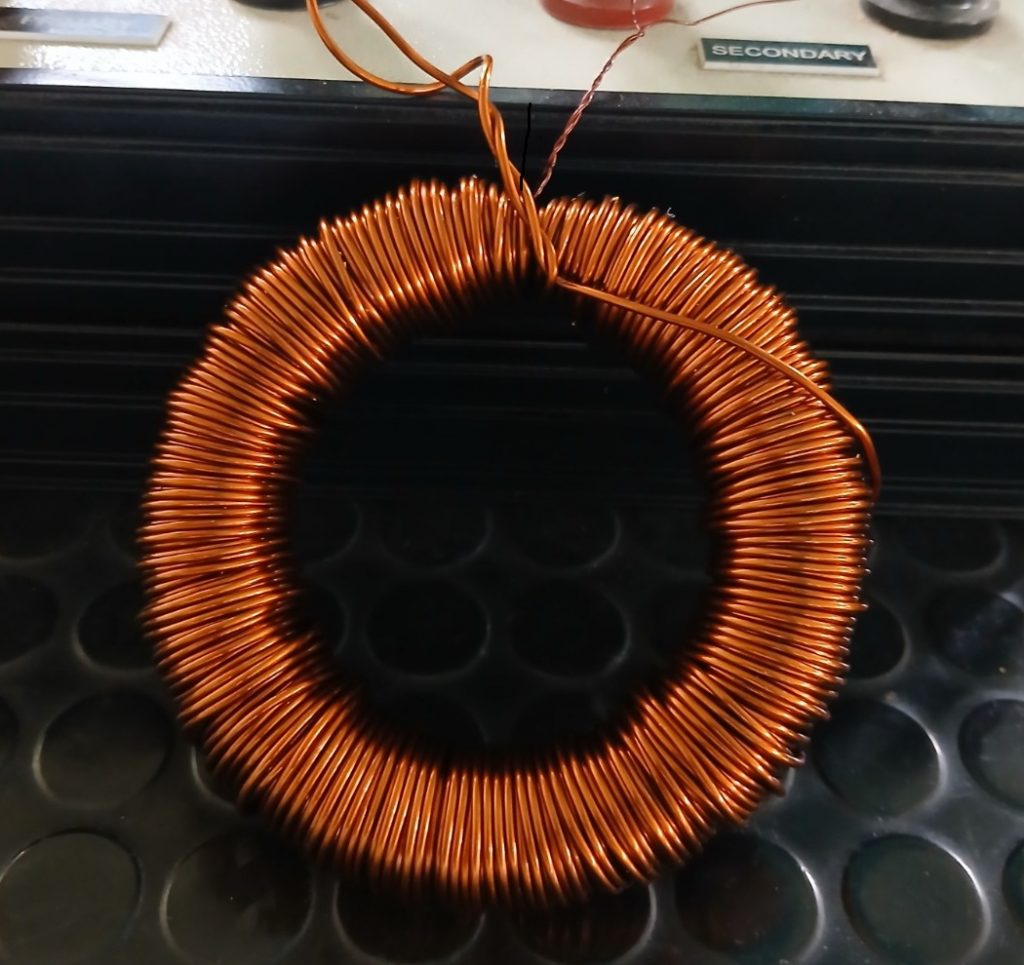
To address this limitation, the samples were reconfigured into a toroidal geometry suitable for controlled magnetic testing. The toroidal dimensions were defined through technical evaluation to ensure optimized magnetic path continuity, dimensional accuracy, and minimal air-gap influence. This adaptation enabled reliable toroid testing.
Comprehensive magnetic testing was conducted under controlled excitation conditions, including full B–H loop analysis and derivation of key parameters such as coercivity (Hc), permeability (μ), saturation characteristics, and hysteresis behavior. The toroid testing configuration ensured uniform flux distribution and improved repeatability.
Structured reports with graphical B–H curves and parameter tables provided production-relevant data, supporting confident engineering decisions.
This engagement reinforced an important lesson: each technical challenge strengthens process capability. By addressing geometry constraints through structured toroid testing, both measurement reliability and technical maturity were enhanced — demonstrating that every challenge contributes to stronger engineering outcomes.
Result & Impacts
Successful magnetic validation of previously untestable plate samples
Reliable, repeatable BH loop data suitable for R&D and application decisions
Eliminated uncertainty around sample preparation and test methodology
Reduced customer effort, time, and technical risk